
REVIEW · SANTO DOMINGO CITY TOURS
Guided Tour in the Colonial Zone of Santo Domingo
Stroll the Colonial Zone, then look up, a lot. This 3-hour guided loop in Santo Domingo links major monuments with Ministry of Tourism certified staff and smart stop timing. It is a great way to get oriented fast, without turning your day into a museum scavenger hunt.
I really like two things right away. First, the focus on clear historical context keeps the streets from feeling like just photos. Second, you get ticketed access to several big hitters, including the Museo del Ron y la Cana and the Royal Houses museum, so you are not paying extra every step.
One caution: the tour moves quickly, and not every stop has included admission. If you end up paying add-ons (or a museum is closed on the day), the value can feel thinner, even though the walk itself is still interesting.
Key points before you go
- Ticketed entry to top sites like Museo de las Casas Reales, Primada Cathedral, National Pantheon, and the Rum and Cane Museum
- A fast, first-time-friendly route that mixes Gothic architecture with colonial-era ruins and plaques
- Great guide potential, with a guide named Angel especially praised for being supportive and patient
- Some stops are walk-bys or have admission not included, so you may not go inside everything
- Small-to-medium group feel with a maximum of 50 travelers, usually manageable for questions
Other trips west to the capital

A 3-hour Colonial Zone route that actually helps you orient
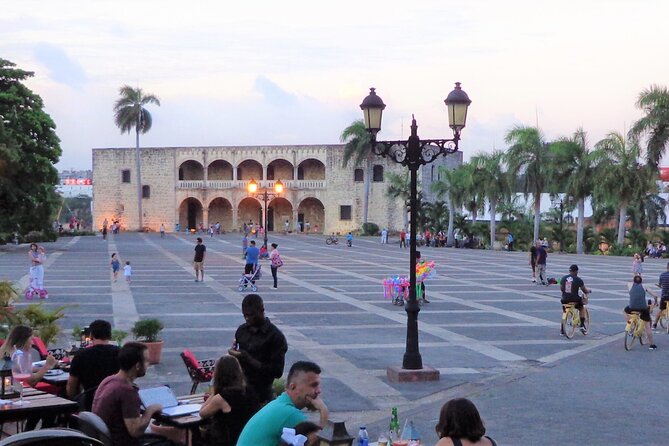
Santo Domingo’s Colonial Zone can feel like a maze at street level, but this tour gives it a storyline. You start in the heart of the historic area and work through the biggest landmarks in a way that helps you understand how the Spanish built power, worship, and everyday life side by side.
What makes this format work is the mix of “inside” and “outside.” You get museum time where you can slow down, then quick walks for landmarks that are best experienced in context. Think cathedral facades, fortress walls, convent ruins, and the simple geometry of old streets that still guide where you should look.
This is also the kind of tour where a good guide matters more than people expect. In reviews, the guides who kept things organized and answered questions helped turn a list of sites into a coherent picture. If you enjoy learning, ask questions early. Guides do best when they know what kind of traveler you are: history-first, architecture-first, or just trying to understand what you are seeing.
Price and value: what $65 covers, and what it does not
The posted price is $65 per person, and the tour includes museum tickets to several key stops. That matters because Colonial Zone admissions can add up fast if you are doing this on your own.
From the included tickets, you can plan on entering:
- Museo De Las Casas Reales (Museum of the Royal Houses)
- Catedral Primada de las Américas de Santo Domingo
- National Pantheon
- Museo del Ron y la Cana (Rum and Cane Museum)
Then there are stops where admission is not included, including:
- Fortaleza Ozama
- House of Tostado (La Casa de Tostado)
- Alcázar de Colón
- Museo Casa Duarte
And you also get several free exterior stops, like Calle Las Damas, Calle El Conde, Parque Colón, Monasterio de San Francisco, Dominican Convent, and Hospital Saint Nicholas of Bari.
So here is the value check I recommend you do: if you want the Royal Houses museum, the Primada Cathedral, the National Pantheon, and the Rum museum, this price can feel fair because you are buying into the most “scheduled” parts of the day. If your priority is to go inside every single building, expect possible extra costs at the non-included museums and palaces.
One more reality check: the time is listed as about 3 hours. That means short interior visits, quick transitions, and a pace that suits “see, learn, move” more than “sit and linger.”
Included museums: Museo De Las Casas Reales and the Cathedral
Museo De Las Casas Reales (30 minutes, ticket included)
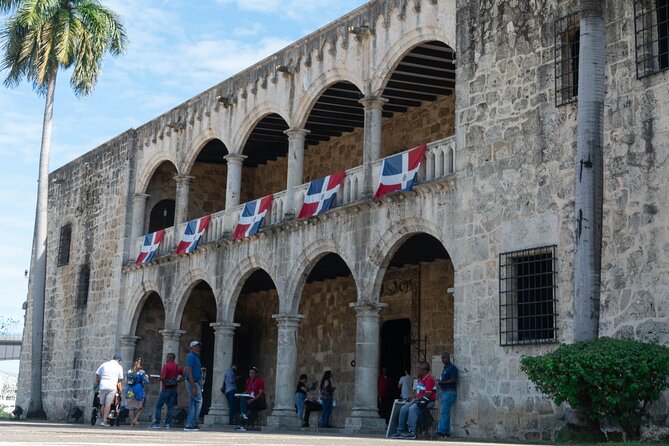
This is one of the tour’s anchors. The Royal Houses complex, sometimes described as the Royal Palaces, dates back to the 16th century. The key detail is that it functioned as the headquarters with two palaces from the captaincy general era, and the museum format helps you connect buildings to governance, wealth, and Spanish colonial power.
Thirty minutes sounds short, but it is often enough to get the big themes without burning your whole day. I like this stop because it gives you a “lens” you can carry to the rest of the walk. When you later see the cathedral, fortifications, and official-looking structures, you start noticing how the city was organized to project authority.
A few more Dominican Republic days worth a look before you book
- Half Day Private Tour in Dominican Republic with Local Guide
★ 5.0 · 113 reviews - Full-Day Guided Tour in santo Domingo
★ 4.5 · 58 reviews - Guided Tour in Four Wheels (ATV) by Macao Beach, Taíno Cave and Typical House
★ 4.5 · 58 reviews - Private Half Day Tour in Dominican Republic with Local Guide
★ 5.0 · 49 reviews - Shared 2 hours Sosúa Bay Snorkeling with Professional Guide
★ 5.0 · 46 reviews
Catedral Primada de las Américas (15 minutes, ticket included)
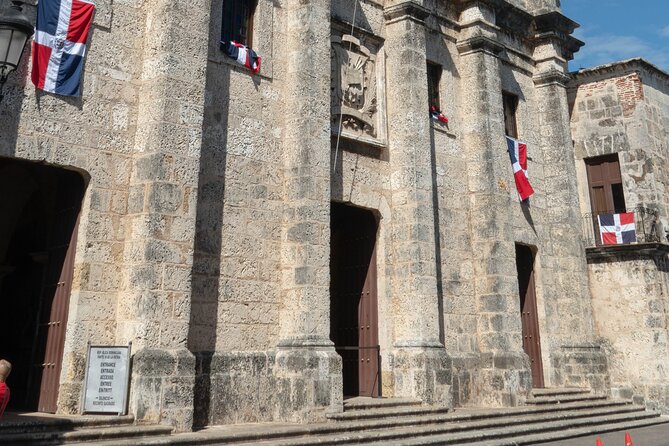
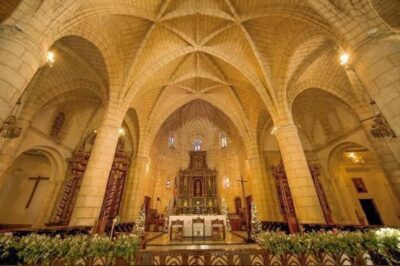
The cathedral experience is about architecture in a tight window. You are looking at a Gothic style with ribbed vaults, solid walls, and three doors, with two Gothic and a third that is described as the main Gothic element.
Fifteen minutes can feel fast, but for many visitors it is enough time to register the big forms and take in the doorways and interior space. If you are the type who loves to photograph details, arrive ready to focus. I recommend choosing one or two features to study, not trying to capture everything at once.
Fortaleza Ozama, Casa de Tostado, and the power behind the stones
Fortaleza Ozama (5 minutes, admission not included)
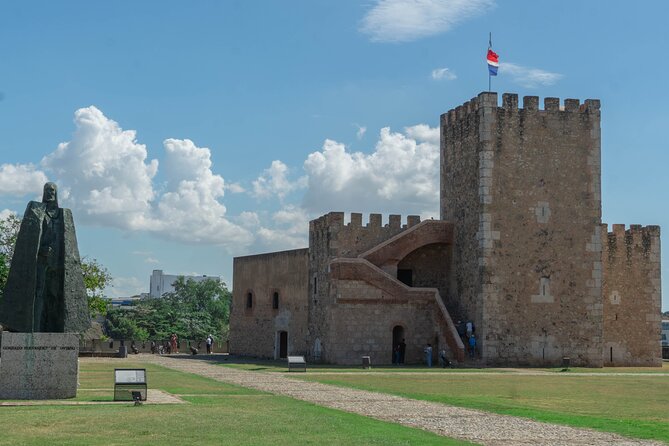
This is more of a “see it, read it, move on” stop. The fortress is a major colonial-era structure, described as one of Santo Domingo’s historical cultural monuments. Built by the Spanish during the colonial era, it is the kind of place that makes you understand why the city had walls and strongholds.
Because admission is not included and the time is brief, do not plan on a full exploration here. Instead, treat it as a visual anchor and listen for the explanation of what a fortress meant in that period.
House of Tostado (5 minutes, admission not included)
Even without included entry, this stop can be memorable because of the facade details. The House of Tostado gets its name from its first owner, Francisco Tostado de la Peña, a notary public of the governor.
The standout clue is on the facade: a twin window in Elizabethan Gothic style, described as unique in America. In other words, this is a “look up” moment. If you like architecture quirks, you will probably enjoy it more than you expect, even if you do not go inside.
The streets that explain everyday Colonial Zone life
After the big monuments, the tour shifts to streets and plazas, and that is where your understanding starts to stick.
Calle Las Damas (free, 5 minutes)
This is called the first street in Santo Domingo and America. The name story is tied to the early colony days, when ladies walked there. It is a small stop, but it humanizes the city. You start thinking about movement, daily routines, and how people actually lived in the same space as kings and bishops.
Calle El Conde (free, 10 minutes)
Calle El Conde is described as the only pedestrian street in the capital and the commercial center of the Colonial Zone. It is also described as one kilometer long, so you get a sense of how dense and walkable the historic core really is.
If you want souvenirs, snacks, or a place to rest your feet later, this is where you can naturally do it after the tour finishes.
Parque Colón (free, 5 minutes)
Parque Colón served as a main party center in colonial-era society and is used today as a center for cultural events. It is another quick stop, but it adds mood. Monuments tell you about power. Plazas tell you about social life.
World Heritage ruins: San Francisco Monastery and the Dominican Convent
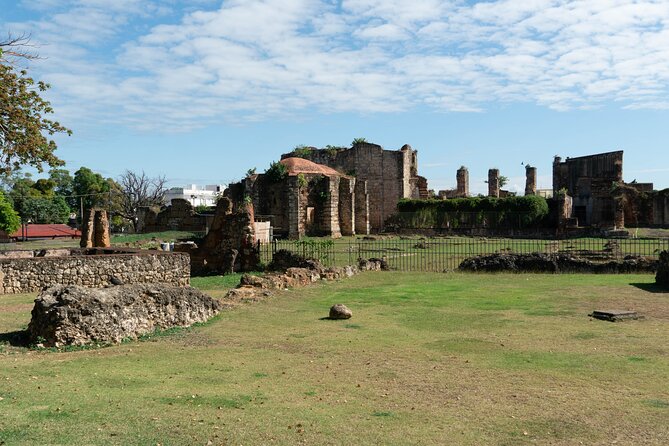
Monasterio de San Francisco (free, 5 minutes)
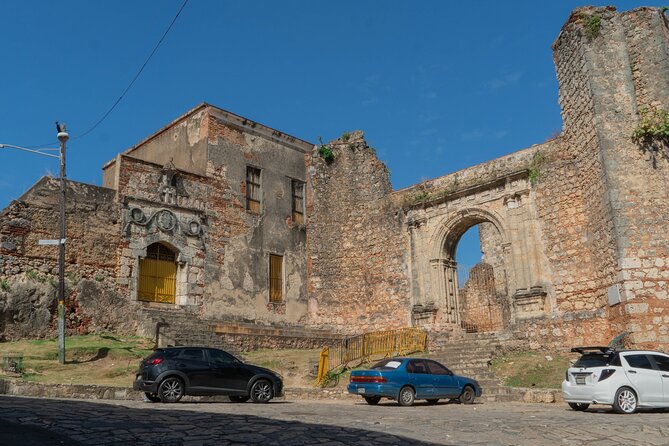
This one is a short look at important ruins. It is described as one of the most important ruins in the Dominican Republic and a World Heritage Site. Even at a glance, ruins do something that standing museums cannot: they show what time actually did to a place.
If you enjoy history through physical evidence, this is the stop that usually feels most “real.”
Dominican Convent (free, 5 minutes)
This church and convent is described as the oldest Catholic building in the American continent, and the first in the New World and Santo Domingo. That is a big claim, and the tour uses this stop to place Santo Domingo early in the story of Christianity in the Americas.
Because the time is short, focus less on trying to see everything and more on understanding why it is significant.
National Pantheon and Hospital San Nicolás: civic pride and early medicine
National Pantheon (10 minutes, ticket included)
The National Pantheon is part of the cluster of key national monuments in the Colonial Zone. It is presented as a mausoleum for Dominican national heroes, so your mental shift here is important: this is not only about colonial Spanish rule. It is about what the Dominican Republic chose to remember.
Ten minutes is a modest window, but pantheons work best when you are ready to read the symbolism. If the guide explains who it honors and why, this stop can become one of the more meaningful moments on the route.
Hospital Saint Nicholas of Bari (free, 5 minutes)
This stop is easy to miss if you only think of hospitals as modern buildings. Here, it is described as the first hospital in America, with construction beginning in 1503 and founded by Nicolás de Ovando.
Even if you just take in the basics, it is a powerful reminder that the Colonial Zone is not only churches and palaces. It includes early institutions that shaped daily life, including health care.
Alcázar de Colón and Museo Casa Duarte: leaders and legitimacy
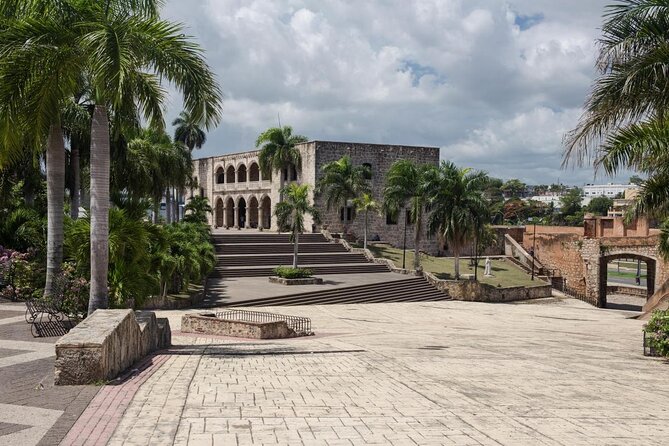
Alcázar de Colón (20 minutes, admission not included)
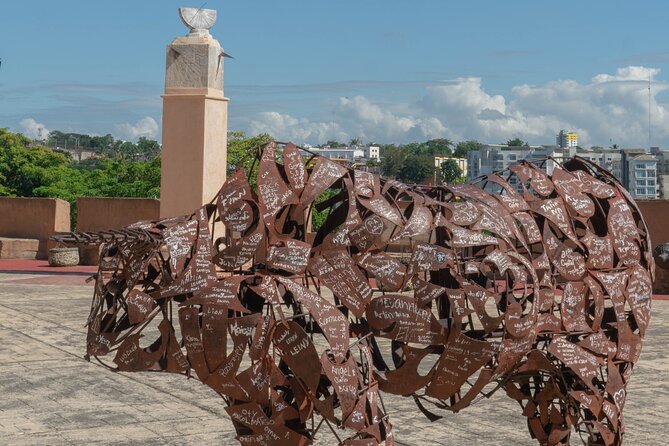
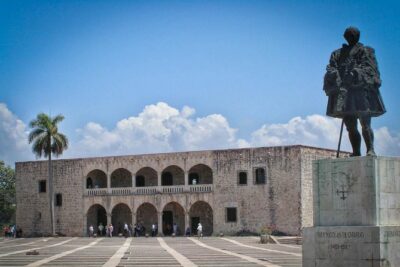
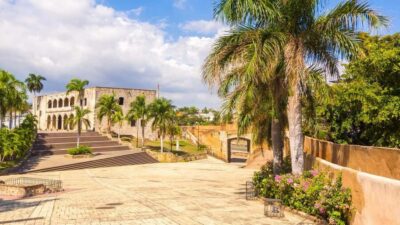
The Alcázar de Colón is described as a palace from the beginning of the 16th century, located in the Plaza de España. This stop matters because it sits in a plaza setting that connects the palace story to the broader civic space around it.
Since admission is not included, you should treat this as a guided “what you are looking at” stop unless you already planned extra entry time on your own.
Museo Casa Duarte (20 minutes, admission not included)
This is dedicated to Juan Pablo Duarte, born in 1813, and his home. The tour frames it as a place tied to his legacy and connected to a World Heritage designation as well.
Again, admission is not included, so your experience here depends on whether you choose to add the ticket. If you are especially interested in independence-era figures and national identity, this stop could be worth the extra cost. If not, you may still find the exterior and explanation useful for context.
Museo del Ron y la Cana: the interactive closer that keeps the tour fun
Rum and Cane Museum (20 minutes, ticket included)
This is the stop that tends to keep people smiling. The Rum and Cane Museum is described as interactive and tells the history of Dominican rum. It gives you a sensory break from religious and political landmarks and adds a modern cultural thread to the colonial story.
Because it is ticketed and listed as a dedicated 20-minute visit, it also functions like a pressure valve. After walking and looking up at stonework, you get to step into an exhibit where the pace can feel more comfortable.
I like including a food or drink themed museum in a history tour because it gives you a different way to remember what you learned. You do not just carry facts. You carry a story you can taste.
Guide quality, group size, and how to handle a day that goes sideways
This tour caps at 50 travelers and is described as having expert staff certified by the Ministry of Tourism. There are guides in several languages, which is great if you are traveling with a friend who needs Spanish or another language support.
Now, here is the part I think you should plan for: a short tour like this is very dependent on smooth operations. If a major indoor stop is closed or a guide does not have the day’s itinerary straight, you can lose value quickly, because you do not have much time to replace what is missed.
So I suggest a simple move at the start: listen closely to the plan and confirm which included museums you will enter today. If you spot a mismatch, speak up right away. This is also where a friendly, organized guide makes all the difference. In reviews, Angel stood out as patient and supportive, which is exactly what you want when timing matters.
If your goal is “I want to see as much as possible,” this is a good format. If your goal is “I want unhurried deep museum time,” you might feel rushed. Either way, you will probably learn something useful because the focus is on connecting the stops into a storyline.
Getting the most out of your 3-hour walk
A few practical tips so the day feels smooth:
- Wear comfortable walking shoes. Even with short stops, you are moving through a dense historic area.
- Bring a light layer. Weather requirements are mentioned, so if the day turns hot or wet, you will want to stay comfortable.
- Use the free street stops strategically. The most important street moments are Calle Las Damas, Calle El Conde, and Parque Colón. If you only half look, you miss what ties the monuments to real life.
- Decide early if you want the add-on museums. Alcázar de Colón and Museo Casa Duarte are listed as admission not included. If those matter to you, plan budget and time accordingly.
Also, note that the tour starts and ends back at the meeting area. The meeting point is C. Arzobispo Meriño 206, Santo Domingo 10210. If you are using rideshare or walking from a hotel, give yourself a little buffer so you are not sprinting to catch the group.
Should you book this Colonial Zone guided tour?
Book it if you want:
- A tight, organized orientation to Santo Domingo’s Colonial Zone
- Included entry to major stops like Royal Houses, Primada Cathedral, National Pantheon, and the Rum museum
- A guide who can translate the setting into a story you can understand quickly
Skip or reconsider if:
- You mainly care about entering every building and you hate add-on tickets
- You are the type who needs long museum time at each location, because this is about moving through highlights
- You are going on a day when you suspect closures or delays might happen, since one missed indoor stop can reduce perceived value fast
My bottom line: for the posted price, this tour is a solid way to experience the big monuments and get a cultural break with the interactive rum museum. Just go in with realistic expectations about the quick pace and the fact that a couple of major sites are not included for admission, so your experience will depend on whether you choose to pay for those entries on the day.
FAQ
How long is the guided tour in the Colonial Zone of Santo Domingo?
The tour lasts about 3 hours.
How much does the tour cost per person?
The price is $65.00 per person.
Where does the tour start?
The meeting point is C. Arzobispo Meriño 206, Santo Domingo 10210, Dominican Republic.
What is included in the price?
Museum tickets are included for several key stops, including Museo De Las Casas Reales, Catedral Primada de las Américas de Santo Domingo, National Pantheon, and Museo del Ron y la Cana.
Which stops have admission tickets not included?
Admission tickets are listed as not included for Fortaleza Ozama, House of Tostado (La Casa de Tostado), Alcázar de Colón, and Museo Casa Duarte.
Is the tour mostly free stops or mostly ticketed stops?
It is a mix. Several stops are free, and several have included admission tickets. Free stops include Calle Las Damas, Calle El Conde, Parque Colón, Monasterio de San Francisco, Dominican Convent, and Hospital Saint Nicholas of Bari.
Are there guides in multiple languages?
Yes. The tour offers guides in several languages.
What is the group size limit?
This tour/activity has a maximum of 50 travelers.
What happens if weather is poor or if I need to cancel?
The tour requires good weather. If it is canceled due to poor weather, you will be offered a different date or a full refund. You can cancel up to 24 hours in advance for a full refund. If you cancel less than 24 hours before, the amount you paid will not be refunded. Service animals are allowed.
More Tours in Dominican Republic




More Tour Reviews in Dominican Republic




The Capital, Three Hours West


Newly reviewed near Dominican Republic
- Punta Cana Jet Ski, Buggy, Aqua Kart & Water Park Access★ 3.5 · 7 reviews
- Saona Island Premium- Exclusive Beach And Mano Juan FullDay★ 3.6 · 7 reviews
- Cap Cana Hotels To Punta Cana Airport (PUJ) One Way★ 5.0 · 8 reviews
- Punta Cana Airport to PARADISUS PALMA REAL in Punta Cana R/T★ 5.0 · 8 reviews
- ATV Rental in Jarabacoa★ 5.0 · 8 reviews
- Punta Cana Airport to ALL OCCIDENTAL RESORTS in PUNTA CANA R/T★ 5.0 · 8 reviews
Santo Domingo City Tours, compared.
 ★ 4.5Full-Day Santo Domingo City Tour from Punta CanaFrom $954,500 reviews
 ★ 3.5Day Trip to Santo Domingo from Punta CanaFrom $55659 reviews
 ★ 3.8Santo Domingo Day Trip with Tickets and LunchFrom $82584 reviews
 ★ 4.1All Inclusive Santo Domingo Full-Day City TourFrom $70553 reviews
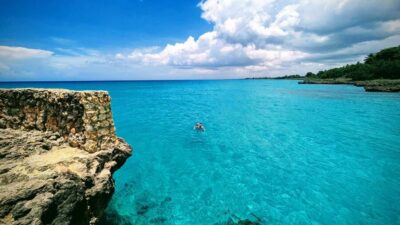 ★ 4.8Los Tres Ojos, Boca Chica & MoreFrom $87219 reviews
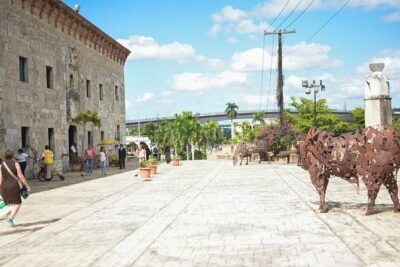 ★ 4.0Historical Santo Domingo Day Trip from Punta CanaFrom $95176 reviews
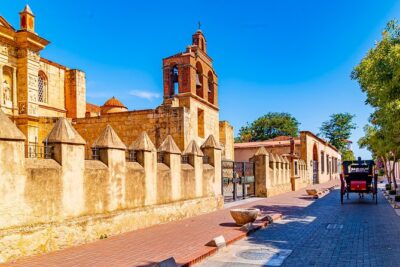 ★ 4.5Walking Tour from Santo Domingo CityFrom $60167 reviews
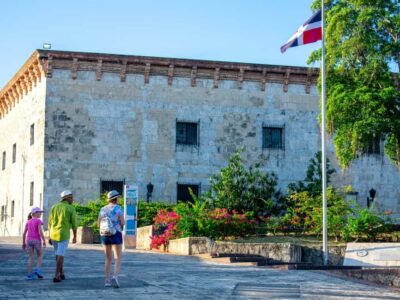 ★ 3.6Santo Domingo Colonial City TourFrom $85129 reviews
Also filed under